

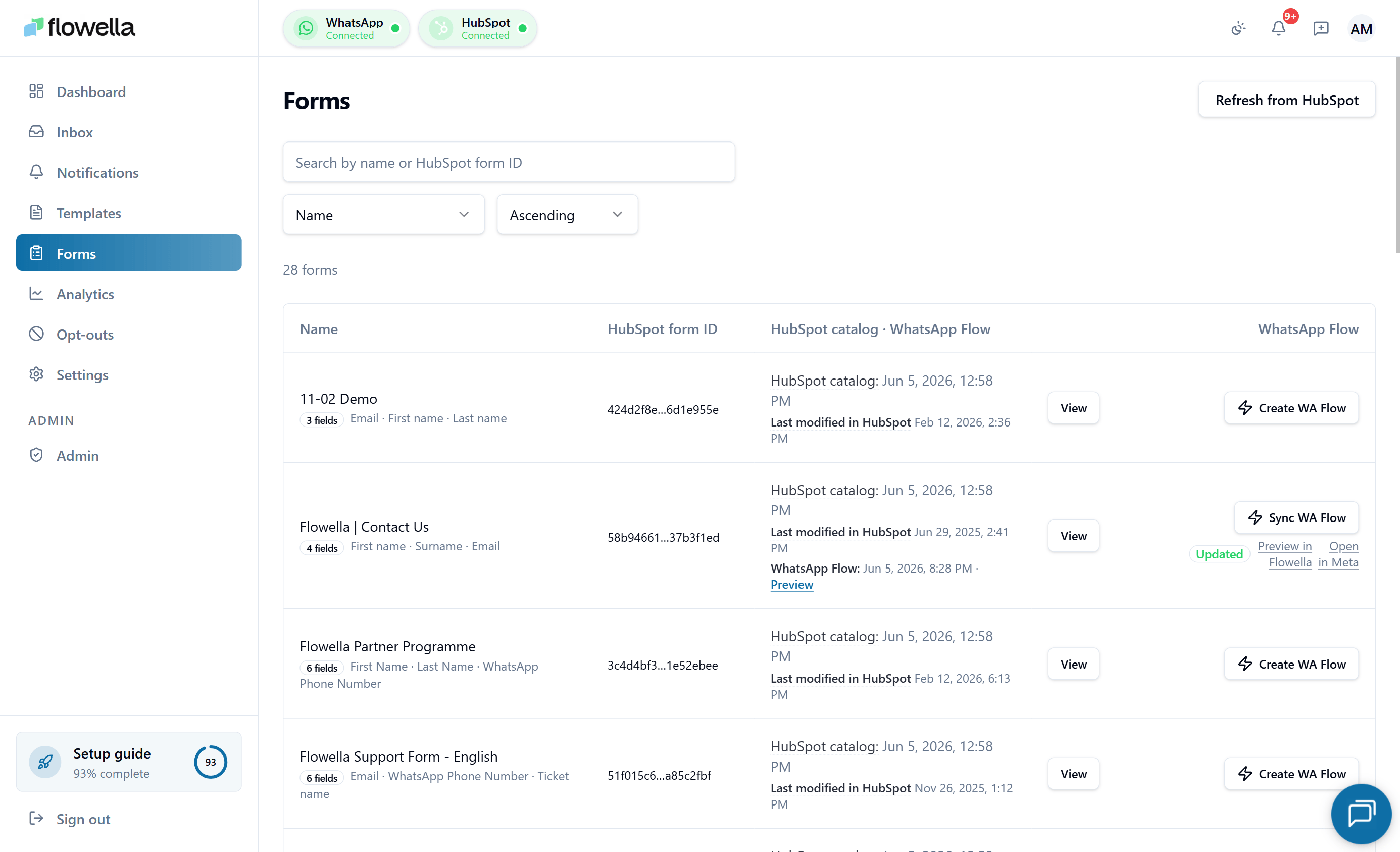
The module was renamed from Forms to Flows in v2.6.31. HubSpot source objects are still called forms — the rename only affects the Flowella sidebar entry, page heading, and URL. Bookmarks to
/{org}/forms continue to work: Flowella issues a permanent 308 redirect to /{org}/flows.How to open it
Go to Flows in the left navigation, or:/{org}/{waba}/{phone}/flows. The list is the same. The channel scoping is used when you sync a Flow to Meta.
What the list shows
Each row represents one HubSpot form. Columns include:- Form name and a truncated HubSpot form ID with a one-click copy button.
- Field count — how many fields the form has, with a flag if any are unsupported.
- Last modified in HubSpot — pulled from HubSpot’s own
updatedAtso you can tell when the form definition itself changed. - WhatsApp Flow status — synced, draft, or stale (HubSpot has changed since the last sync).
- Drift indicator — when the HubSpot form has been edited since the last Flow was built from it, the row shows an amber HubSpot form changed since this Flow was built — sync again to pick it up label. Trigger a fresh sync to clear it.
- Create WhatsApp Flow / Sync WhatsApp Flow — the primary action. The label switches to Sync when a Flow already exists and to Stale — Sync needed when the HubSpot form has been edited since the last sync.
Background catalog sync
Flowella keeps the Flows list up to date automatically, so newly added or renamed HubSpot forms appear without you clicking anything:- When you open the page, Flowella serves the cached catalog immediately and enqueues a fresh sync in the background if the catalog is older than 5 minutes.
- Every 20 minutes, a background sweep re-syncs the catalog for every organisation whose HubSpot integration is CONNECTED, so lists stay current even for tabs no one has opened.
- While a background sync is running, the header shows Updating… next to the refresh icon. When it finishes, the label switches to Last synced 2 minutes ago (or the equivalent relative time). The list refreshes in place.
Form detail
Click a row to open its detail page. The detail header shows the same Create / Sync WhatsApp Flow primary action as the list row, so you don’t have to go back to make changes. From the detail page you can:- Review the field-by-field mapping between the HubSpot form and the WhatsApp Flow.
- See past sync runs — when each was started, status (queued, running, succeeded, failed), and any errors Meta returned.
- Trigger a new sync, retry a failed run, or cancel a sync that is still in progress.
- Open the corresponding Flow in Meta Business Suite.
- Check which version of the HubSpot form the published Flow was built from. When a Flow has been synced, the header shows Flow built from HubSpot form as of 12 Sep, 14:03. Compare it against the current Last modified in HubSpot value to decide whether you need to re-sync.
Syncing a form to a WhatsApp Flow
When you click Create WhatsApp Flow or Sync WhatsApp Flow, Flowella:- Runs a preflight check — confirms HubSpot is connected, the active channel is verified, the form has at least one supported field, and billing is active.
- Reads the latest form definition from HubSpot.
- Generates the equivalent WhatsApp Flow JSON.
- Uploads it to Meta on the channel you have selected (channel-scoped).
- Records the sync run on the detail page and stamps the Flow built from HubSpot form as of timestamp so drift can be detected on later edits.
Channel scope gating
Flows are org-wide in the list but channel-scoped when you sync — a Flow has to be uploaded against a specific WABA + phone number combination.
If you click Sync from the org-wide URL and Flowella can’t decide which channel to use (no channels connected, multiple channels with no scope set, or a stale cross-org session), the button stays pre-disabled with a tooltip explaining what’s missing. Switch into the correct channel from the channel switcher, or open
/{org}/{waba}/{phone}/flows directly.
Sync error UX
When a sync fails, Flowella turns the run row into a single outline action button so you can fix forwards from the same row:
The row also carries a user-safe error badge:
FLOW_SYNC_PREFLIGHT+ Meta error#133010(phone not registered) — the badge shows the stored Meta message and a phone-registration hint, not a generic “not ready”. Finish phone registration in Settings → Meta and retry.QUEUE_FAILED— the sync queue couldn’t pick up the job. Usually transient; retry. If it persists, the platform status page is the next place to check (see Status & incidents).- Meta
validation_errors— the badge summarises which fields Meta rejected, so you can adjust the HubSpot form (or the field mapping) and retry without leaving the row.
Flow submissions attach to the enrolled HubSpot contact
When a WhatsApp Flow is sent from a HubSpot workflow, Flowella now passes the enrolled HubSpot contact id through the Flow and includes it ashs_object_id when the submission is written back to HubSpot. This makes the submission attach to the exact contact that HubSpot enrolled — not a lookalike record — even when the phone number matches multiple contacts, and it removes the last case where the HubSpot phone lookup could fall back to the wrong record.
If your organisation already has published Flows, re-sync each Flow once so the new hidden field is included in the Flow JSON uploaded to Meta:
1
Open the Flows page
Go to Flows and open any form whose WhatsApp Flow was created before this change.
2
Trigger a fresh sync
Click Sync WhatsApp Flow on the row (or the primary action on the detail page). Flowella re-uploads the Flow JSON to Meta with the hidden contact id field.
3
Repeat for each active form
Only forms sent from HubSpot workflows need this. Forms sent outside a workflow context are unaffected.
Question copy in rich text blocks
HubSpot lets you place a rich text element above a field group so the question text sits above the input rather than inside the field label. Flowella maps those blocks into the WhatsApp Flow alongside the inputs:
The rich text appears before the inputs in the field group, so customers see the question, then answer it. Field labels are still shown in-app, so keep them short — see Form design best practices.
If you already have HubSpot forms that use rich text above field groups, re-sync them from the form detail page. Older sync runs only picked up field labels, so the rich text question copy was missing from the published Flow until you sync again.
Thank-you screen formatting
The same HTML → Flow component mapping now applies to the thank-you copy on a HubSpot form. Headings, bold text, non-breaking spaces, and bullet lists survive the sync instead of being stripped to plain text, and the Done footer is preserved.
Each bullet renders as a single line, so pretty-printed HubSpot markup (a
<p> nested inside each <li>) no longer produces orphan bullet rows on WhatsApp. Headings over 80 characters still fall back to body text, the same as elsewhere in the Flow.
If a form was synced before this change, its Flow still carries the plain-text thank-you copy. Open the form detail page and re-sync to pick up the new formatting.
Sample data
If you have no HubSpot connection yet, the Flows page renders with illustrative rows behind a “Sample data” callout. Connect HubSpot to switch to your real forms.A form can sync perfectly and still read badly on a phone. Long field labels are shortened on screen, most noticeably on iPhone, and the wrong question type makes it worse. See Form design best practices before you build a form.
Related
HubSpot setup
Connect the portal Flowella reads forms from.
Form design
Build HubSpot forms that render cleanly on every device.
Workflow actions
Trigger Flows from a HubSpot workflow.
Workflow guides
End-to-end recipes that combine forms, templates, and workflows.
HubSpot sync failures
Diagnose form sync issues and missing submissions.
Multi-channel
Flows are synced per channel — understand the scoping.
Data security
How form submissions are encrypted in transit and at rest.